Screen Time and Speech Delay: The Honest Truth
Does screen time cause speech delay? The honest answer is nuanced, and free of shame. Here is what screens really do to a young child’s language, and simple swaps that help them talk more.
You have probably seen the alarming headlines and the judgemental comments: screens are ruining children’s speech, put the tablet down, it is all the phone’s fault. And if your child has a speech delay and also enjoys screens, you may be quietly blaming yourself. Let me give you an honest, shame-free look at what is actually true, because the reality is more nuanced than the headlines, and understanding it helps your child far more than any amount of guilt ever could.
I am Priyanka Singh, an RCI registered speech therapist and special educator in Varanasi. Let me explain what screens really do to young children’s language, what the honest concern is, and and the simple, practical changes that genuinely help your child talk more, all without a shred of judgement.
How children actually learn language
To understand the screen question, you first have to understand how young children learn language, because it explains everything. Children do not learn to talk simply by hearing words. They learn through warm, responsive, back-and-forth interaction with real people.
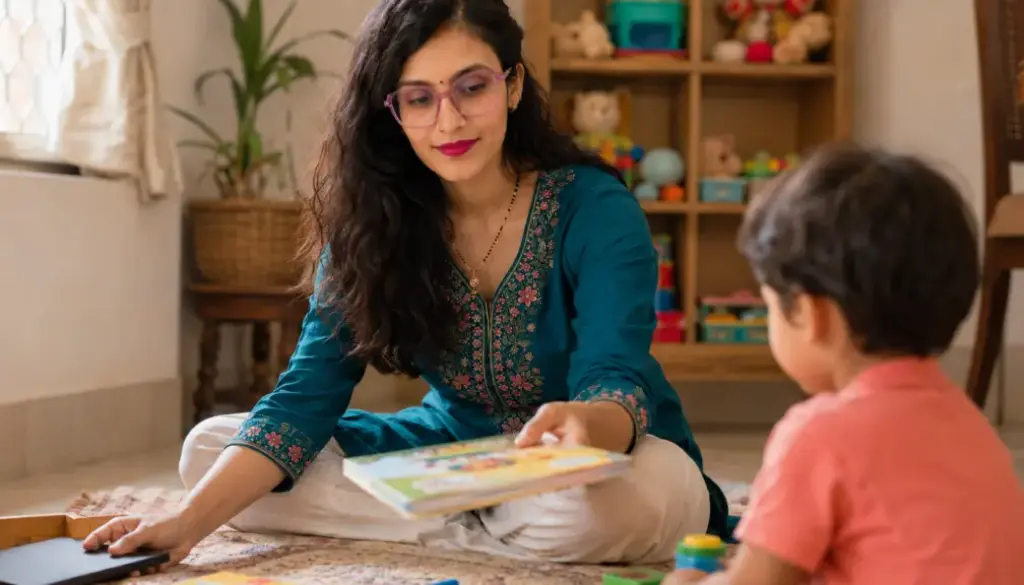
When you talk with your child, something rich happens. You respond to them. You follow their gaze and name what they are looking at. You pause and wait for their turn. You react to their sounds and words with delight. This living, responsive exchange is how language is built, and it is something a screen, however educational, fundamentally cannot provide. A screen talks at a child; it does not talk with them.
The honest concern with screens
So here is the honest concern, stated fairly. The problem with too much screen time is not usually some direct harm from the screen itself. It is what the screen time replaces. Every hour a young child spends passively watching is an hour not spent in the rich, responsive interaction through which language grows.
This is called displacement, and it is the real issue. When screens fill large parts of a young child’s day, they displace conversation, play, reading together, and all the warm exchanges that build language. The child simply gets less of what they most need. On top of this, screens can reduce interaction even when everyone is present, if the household is often absorbed in devices rather than talking together.
No shame, just information
Let me be clear and kind about this, because shame helps no one. If your child watches screens, you are not a bad parent, and you have not ruined their speech. Nearly every modern family uses screens, and they can offer parents a genuinely needed and well-deserved break. This is not about guilt. It is about information you can use.
And screens are not uniformly harmful. The concern is specifically about large amounts of passive screen time in very young children displacing interaction. Understanding this lets you make small, practical adjustments that protect what matters, without needing to eliminate screens entirely or feel terrible about them. Knowledge, not shame, is what helps your child.
Simple swaps that help
Here is the practical, hopeful part. You do not need to eliminate screens entirely. You simply need to protect and increase the rich interaction your child needs. Small, realistic changes make a real difference.
- Reduce passive screen time, especially for very young children, in favour of interaction
- Fill some of the freed-up time with talking, playing, and reading together
- When screens are used, watch together and talk about what you see
- Keep mealtimes screen-free and use them for conversation
- Have device-free times when the whole family talks and plays
- Narrate everyday activities: cooking, shopping, bathing, all rich chances to talk
- Read physical books together every day, which is wonderful for language
Notice that the goal is not simply less screen time in the abstract, but more warm interaction. Swapping some screen time for talking, playing, and reading gives your child exactly what builds language. Even modest changes, a screen-free mealtime, a daily story, narrating your day, add up to a meaningful increase in the interaction your child needs.
Watching together beats watching alone
One more practical point worth its own mention: when your child does watch something, watching together transforms it. A child watching alone is passive, but a child watching with you, while you talk about what is happening, name things, and react together, is engaged in exactly the kind of interaction that helps. The same screen becomes far more valuable simply because you are sharing it.
So rather than viewing screens as purely good or bad, think about making them more interactive when they are used, and balancing them with plenty of screen-free connection. This realistic, shame-free approach fits real family life and genuinely helps your child’s language.
Balance, not blame
The honest truth about screens and speech is one of balance, not blame. Screens themselves are not villains, but large amounts of passive screen time in young children can displace the rich interaction that language depends on. The solution is not guilt or a total ban, but a sensible rebalancing toward more warm, responsive connection.
So use screens thoughtfully, protect plenty of time for talking, playing, and reading together, and let go of any shame you have carried. Your child learns language above all from you, from your warmth, your attention, your everyday conversations. Give them plenty of that, and you are giving them exactly what they need to thrive, screens or no screens.
Why very young children struggle to learn from screens
There is a fascinating and important reason why screens are particularly poor at teaching language to the youngest children, and understanding it helps you make good choices. Researchers have found that very young children learn remarkably well from real, live interaction, but struggle to learn the same things from a screen, even when the content is identical. This gap is sometimes called the video deficit.
The reason seems to be that young children are wired to learn from responsive, social interaction. When a real person responds to a child, follows their attention, and reacts to them in the moment, the child’s brain engages deeply and learning happens. A screen cannot do this. It cannot notice what the child is looking at, cannot respond to their sounds, cannot adjust to them. To a very young brain built for social learning, the screen is simply less able to teach, however colourful and clever it is.
This is why the same twenty minutes spent with a caring adult, talking, playing, and responding, does far more for a toddler’s language than twenty minutes with even the most acclaimed educational programme. It is not that the programme is bad. It is that live human interaction is uniquely powerful for the developing brain, in a way no screen can replicate. Knowing this makes the value of your own time and attention wonderfully clear.
Making realistic changes in a real family
I know that advice about reducing screens can feel unrealistic when you are a busy, tired parent, perhaps juggling work, a household, and more than one child. Screens exist for good reason, they buy parents a moment to cook, rest, or simply breathe. So let me be practical rather than preachy, because changes that fit real life are the ones that actually happen.
You do not need to eliminate screens or feel guilty every time you use one. Start small and realistic. Pick one or two screen-free pockets in your day, mealtimes are a natural choice, and protect them for conversation. Add one daily story with a physical book. Narrate what you are doing while you cook or tidy, turning ordinary chores into language-rich moments that cost you no extra time. These small, sustainable changes, woven into the life you already live, add up to a meaningful increase in interaction without demanding the impossible.
The aim is not a screen-free household, which for most families is neither realistic nor necessary. The aim is a good balance: screens used thoughtfully, alongside plenty of the warm interaction your child needs. Approached this way, with realism and without guilt, protecting your child’s language becomes something achievable within an ordinary, busy family life, not one more impossible standard to fall short of.
If your child already has a speech delay and enjoys screens, resist the urge to look backward with regret. What matters now is not what has already happened, but what you do from here. Every warm conversation, every shared story, every screen-free mealtime you add from today onward helps your child. The past is not worth your guilt; the present and future are worth your warm, attentive presence. Start where you are, today, and know that it is genuinely never too late to give your child more of the rich interaction that helps them grow.
This article is part of my complete guide to speech delay. You may also find simple ways to encourage talking at home helpful.
Want practical ways to boost your child’s talking? Let’s chat, gently and for free.
Book your free consultationCall 9196430300Frequently asked questions
Does screen time cause speech delay?
The honest answer is nuanced. The concern is not usually direct harm from screens, but that large amounts of passive screen time in young children displace the warm, back-and-forth interaction through which language is built. It is what screens replace, rather than screens themselves, that is the real issue.
Is my child’s speech delay my fault for allowing screens?
No, please do not blame yourself. Nearly every modern family uses screens, and they are not uniformly harmful. Speech delay has many causes. Rather than guilt, what helps your child is understanding how to balance screens with rich interaction, and making small practical changes.
How much screen time is okay?
Rather than fixing on an exact number, focus on protecting plenty of time for talking, playing, and reading together. The goal is to ensure screens do not displace the rich interaction young children need. Reducing passive screen time, especially for very young children, and increasing warm interaction is the key.
Does watching educational shows help my child talk?
Even educational screens cannot replace the warm, responsive back-and-forth with real people through which language is built. A screen talks at a child, not with them. Watching together and talking about what you see makes screens far more helpful than watching alone.
What is the best way to help my child talk more?
Increase warm, back-and-forth interaction: talk through your day, play together, read physical books daily, keep mealtimes screen-free for conversation, and when screens are used, watch together and talk about them. Swapping some passive screen time for connection gives your child exactly what builds language.