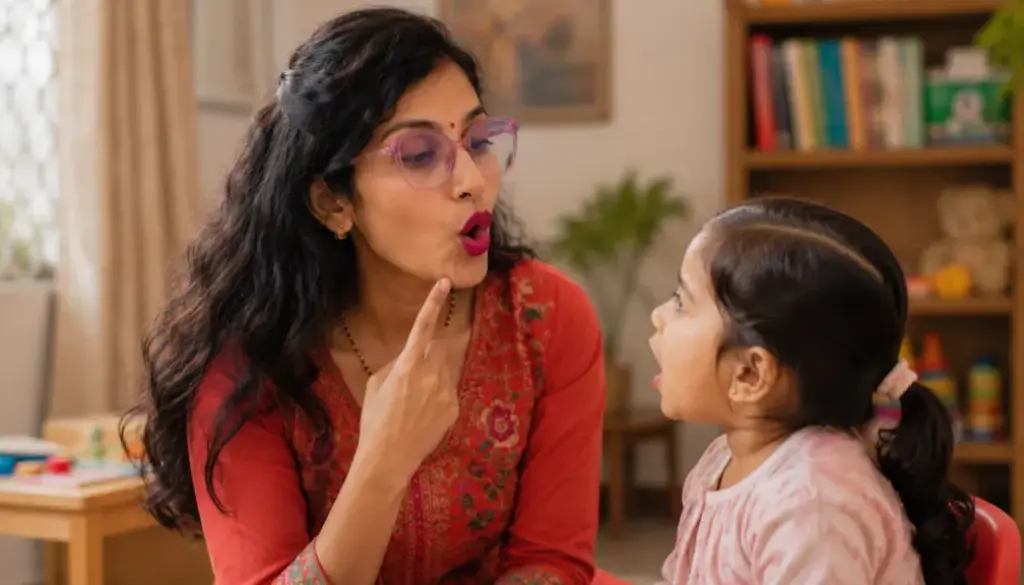
My 3 Year Old Is Not Talking Clearly
By three, most children are chatting in short sentences. If yours is not talking clearly, or barely talking at all, here is what it may mean, and why acting now gives your child the best chance before school.
Three years old is often when a quiet worry becomes harder to ignore. The gap has widened. Other three-year-olds are asking endless questions and telling little stories, while your child speaks in single words, is hard to understand, or barely talks at all. If you are anxious and no longer sure that waiting is right, this guide is for you.
I am Priyanka Singh, an RCI registered speech therapist and special educator in Varanasi. Let me explain honestly what limited or unclear speech at three can mean, what to look at, and why this is an important age to act, calmly and without panic.
First, hold on to this: three is not too late. It is a very good age to help. The window for effective support is wide open, and children who get help at three routinely make wonderful progress. Acting now is one of the best things you can do.
What most three-year-olds are doing
Here is the general picture at three, offered as a guide, not a strict test, since children still vary. It helps to know what is typical so you can see where your child is.
- Speak in short sentences of three or more words
- Be understood by family most of the time, even if strangers struggle
- Ask questions, especially “what” and “why”
- Follow two-step instructions
- Name familiar objects, people, and pictures
- Have a vocabulary of many hundreds of words
- Tell you simple things about their day
If your three-year-old is far behind this, whether through very limited speech, or speech so unclear that even you often cannot understand them, it is worth addressing rather than waiting. At three, the gap does not usually close on its own, and there is real and lasting benefit to acting now rather than later.
Two different situations at three
It helps to distinguish between two things parents often describe at this age, because they point in slightly different directions, though both benefit from help.
The child who barely talks
Some three-year-olds are still using very few words, or single words where sentences would be expected. Here we look carefully at the whole picture: understanding, social connection, gestures, and play. A child with very limited speech who also struggles to understand, or shows differences in social connection, may need a broader assessment. A child who understands well and connects warmly but is simply slow to produce speech has a more straightforward speech delay.
The child who talks but is unclear
Other three-year-olds talk plenty, but their speech is so unclear that family and especially strangers cannot understand them. This is about the clarity of speech sounds rather than the amount of language, and it often responds very well to targeted speech therapy, because we can work directly on the specific sounds the child finds difficult.
Why three is an important age to act
There is a particular reason not to wait at three, and it is worth being honest about. School, in some form, is often not far away. The social and communication demands of a classroom are considerable, and a child who cannot yet communicate clearly can struggle, not just academically but socially and emotionally.
Starting support at three gives us time to build your child’s communication before they face that busy, demanding world. It also heads off the knock-on effects that unaddressed speech difficulties can have: frustration, behaviour struggles born of not being understood, and the dent to confidence when other children cannot understand them. Acting at three is about far more than words. It is about protecting your child’s whole experience of the years ahead.
How to help at home
Alongside any professional support, there is a great deal you can do at home to encourage your three-year-old’s speech, all through warm, everyday interaction.
- Get down to their level and give them your full attention when they try to speak
- Model correct speech gently: if they say a word unclearly, say it back correctly without making them repeat it
- Expand on what they say: they say “dog run”, you say “yes, the dog is running!”
- Read together every day, talking about the pictures
- Ask simple questions and give them time to answer
- Play turn-taking games that build back-and-forth communication
- Reduce screen time in favour of talking together
Three is a wonderful age to help
If your three-year-old’s speech worries you, please do not let anyone talk you into simply waiting. Three is a genuinely good age to act, right in the heart of the window where support works beautifully. I have seen so many three-year-olds who barely spoke, or could not be understood, blossom into chatty, clear, confident children with the right help.
Whatever the cause, acting now, calmly and with love, gives your child the very best chance to communicate well before school and beyond. You are not too late. You are right on time, and you do not have to work it out alone.
Common causes of speech difficulty at three
Parents often want to understand why their three-year-old is struggling with speech. There are several common causes, and knowing them helps you understand that this is rarely anyone’s fault, and usually very treatable.
Hearing difficulties
This is the first thing to rule out, always. A child who cannot hear speech sounds clearly cannot copy them clearly. Repeated ear infections, very common in young children, can cause fluctuating hearing loss that quietly holds speech back. A simple hearing test is essential, and treating a hearing problem can transform a child’s speech.
Difficulty with speech sounds
Some children hear perfectly well but have difficulty coordinating the precise movements of the lips, tongue, and jaw needed to produce clear speech sounds. This is one of the most common and most treatable causes of unclear speech, and targeted therapy works directly and effectively on it.
A language delay
Other children are delayed in language itself, the words and sentences, rather than just the sounds. They may understand well but be slow to produce spoken language. With the right support and plenty of rich interaction, many of these children catch up well.
Part of a broader picture
Sometimes speech difficulty is one part of a wider developmental picture, such as autism, especially when accompanied by differences in social connection and understanding. This is why a good assessment looks at the whole child, not just their speech, so that whatever is going on can be understood and supported properly.
When people tell you to wait
At three, as at every age, you will likely encounter people who tell you not to worry, that your child will talk when ready, that a relative was just the same. Sometimes they are right. But I want to be honest with you: at three, waiting is a bigger gamble than it was at eighteen months, because the window before school is closing and the gap is less likely to close on its own.
This does not mean you should panic. It means that if you have real concerns at three, the wisest response is not to wait and hope, but to get a professional opinion. If all is well, you will be reassured. If help is needed, you will have started it at a genuinely good age. Neither outcome involves the regret that so often follows waiting too long. Trust your concern enough to act on it.
Let me share something that might reassure you. Some of the children I remember most fondly arrived at age three barely able to make themselves understood, their parents anxious and worn down by months of being told to wait. Within months of the right, playful support, those same children were chatting away, being understood, and glowing with the confidence that comes from finally being able to say what they mean. That transformation is not rare. It is what good, timely help at three so often achieves.
So if you take one thing from this, let it be hope paired with action. Your three-year-old’s speech difficulty is very likely something that can be helped, often considerably, and three is a wonderful age to begin. The sooner you understand what is going on, the sooner your child can be on their way to communicating with ease.
One last practical note: when you seek help, look for a professional who is RCI registered and who takes real time to understand your child as a whole person, not someone who rushes to conclusions in a few minutes. The right person will observe carefully, involve you fully, and explain clearly what they find. That kind of thorough, warm assessment is what your three-year-old deserves, and it is what leads to help that genuinely fits them.
What might be behind it
Parents naturally want to understand why their three-year-old is behind with speech. There are several common reasons, and knowing them helps you and any professional work out what will help most. Often more than one factor is at play.
Hearing difficulties
This is always the first thing to rule out, because it is common and easily missed. A child who cannot hear clearly, whether from a permanent hearing loss or from the very common glue ear that follows repeated ear infections, cannot learn to speak clearly. Many children with unexplained speech delay turn out to have a hearing issue that, once treated, allows their speech to come on. Never skip the hearing check.
Oral-motor difficulties
Sometimes a child understands language well and knows exactly what they want to say, but has difficulty coordinating the muscles of the mouth, tongue, and lips to produce sounds clearly. This is something a speech therapist can assess and work on directly, with targeted exercises and techniques suited to your child.
A language delay
For some children, the difficulty is in language itself, the words and how they go together, rather than just the sounds. These children benefit from support that builds their understanding and use of language, not just their pronunciation.
Part of a broader picture
Occasionally, speech difficulty at three is one part of a wider developmental picture, such as autism, especially where there are also differences in social connection, play, and understanding. This is exactly why a proper assessment looks at the whole child, not just the speech, so that whatever is going on, your child gets the right kind of help.
What getting help looks like
If you decide to seek support, it helps to know what to expect, because the reality is far gentler and more encouraging than many parents fear. Good speech therapy for a three-year-old does not look like a clinic and drills. It looks like play.
A therapist first assesses your child through play and conversation, and by talking with you, to understand exactly where the difficulty lies. Then support is built around your child’s interests and delivered through games and activities they enjoy, so it feels like fun, not work. Crucially, a good therapist also shows you how to help at home, because the warm, everyday interaction you provide is where much of the real progress happens, between sessions.
Progress at three is often genuinely rewarding to watch. Because the young brain is so ready to learn, and because three-year-olds are so eager to communicate, targeted help frequently brings on speech in ways that delight everyone. The frustrated child who could not make themselves understood becomes a child who can finally tell you what they think and feel, and that is a joy for the whole family.
Common causes of speech difficulty at three
Parents often want to understand why their three-year-old is struggling to speak clearly. There are several common causes, and knowing them helps you understand what support might involve. A proper assessment identifies which apply to your child.
Hearing difficulties
This is the first thing to rule out, always. A child who cannot hear speech sounds clearly cannot reproduce them clearly. Repeated ear infections, very common in young children, can cause fluctuating hearing loss that quietly holds speech back. A simple hearing test is an essential first step for any child with speech concerns.
Difficulty with speech sounds
Some children hear perfectly well but find it hard to coordinate the precise mouth movements needed for certain sounds. Their language is developing, but the physical production of clear speech lags behind. This is one of the most common and treatable causes of unclear speech, and responds well to targeted therapy.
A language delay
For some children the difficulty is in language itself, understanding and using words and sentences, rather than just the clarity of sounds. These children may need broader support to build their vocabulary, sentence-building, and understanding, not just sound work.
Part of a wider picture
Occasionally, speech difficulty at three is one part of a broader developmental picture, such as autism, especially when it comes alongside differences in social connection and play. This is why a good assessment looks at the whole child, not just their speech, so that whatever support is offered fits your child’s actual needs.
Do not let anyone talk you out of acting
I want to address something directly, because it costs children so much. At three, you will very likely still hear the familiar reassurances: he is a boy, boys talk late; she will catch up; my child did not talk until four and is fine now; you worry too much. These comments come from love, but they can lead you to wait when acting would serve your child far better.
Here is the honest truth. Some children genuinely do catch up on their own. But there is no way to know in advance which children those are, and the cost of waiting, if your child is not one of them, is high: lost time in the best window, mounting frustration, and a harder start at school. A professional assessment removes the guesswork. It either reassures you that your child is fine, or gets them help at the ideal time.
So please, if your instinct says something needs attention, trust it over the well-meaning reassurances of people who are not experts and who will not bear the cost of waiting. Seeking help at three is wise, not anxious, and it is a decision very few parents ever regret.
This article is part of my complete guide to speech delay. You may also find what to do if your 4 year old is hard to understand helpful.
Worried about your three-year-old’s speech? Let’s talk, gently and for free.
Book your free consultationCall 9196430300Frequently asked questions
Is it normal for a 3 year old to not talk clearly?
By three, a child’s speech should be mostly understandable to family, even if strangers still struggle. If you often cannot understand your own three-year-old, or they barely talk, it is worth addressing. At three the gap does not usually close on its own, and early help works well.
My 3 year old only says single words. Should I worry?
By three, most children use short sentences. A child still using mainly single words is worth a professional conversation. Whether it is a straightforward speech delay or part of a broader picture, three is a good age to get support, and early help makes a real difference.
Why is my 3 year old hard to understand?
Unclear speech at three is often about the production of specific speech sounds. It usually responds very well to targeted speech therapy, because a therapist can work directly on the sounds your child finds difficult. Left alone, unclear speech can persist and affect confidence and school.
Is 3 years old too late for speech therapy?
Not at all. Three is a genuinely good age to start, right in the window where support works beautifully. Starting now also gives valuable time to build communication before school. Children who get help at three routinely make wonderful progress.
How can I help my 3 year old speak more clearly?
Get to their level, model correct speech gently without forcing repetition, expand on what they say, read together daily, ask questions and allow time to answer, play turn-taking games, and reduce screen time. Keep it warm and pressure-free so your child enjoys talking.